CryptoRush: Crypto Simulator
- 4.5
- Rating
- 10.00M
- Installs
- Free
- Price

 Analysis by App-foxy
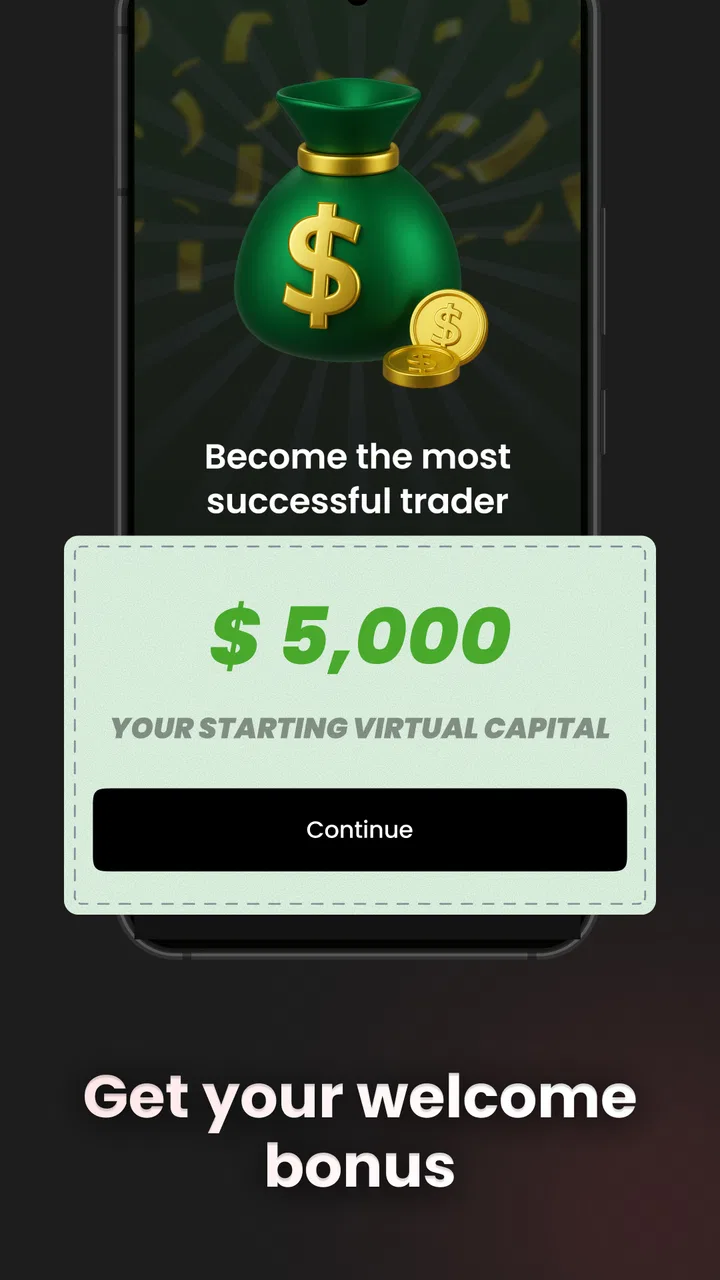
I approached CryptoRush: Crypto Simulator as a practice tool rather than a shortcut to making money. That distinction matters. This free business app, developed by CryptoRush - Trading Academy, places the user in a simulated market environment so trading decisions can be explored without turning a learning session into a real financial transaction. I found its strongest value in the space between curiosity and commitment: it gives beginners somewhere to think through a trade before they start treating a live exchange like a guessing game.
The app has attracted a substantial audience, with an average rating of 4.6 from around 157 thousand ratings and more than 5 million installs. Those figures make it easier to understand why someone might try it, but they do not answer the more important question: what does the experience feel like when you actually use it? My answer is that it is most useful when I give it a specific learning job. If I open it expecting entertainment, instant expertise, or a replacement for a real exchange, the experience feels limited. If I use it to rehearse decisions and examine my own habits, it becomes much more worthwhile.
From curiosity to a controlled trading exercise
My starting point with the app was simple: I wanted to understand how I would react to market movement without placing real funds at risk. That is a realistic situation for many people. You may have watched cryptocurrency prices move quickly, heard friends discuss entries and exits, or opened a live trading platform only to find too many unfamiliar controls. A simulator can reduce that initial pressure by separating the decision from the financial consequence.
You May Also Like

 AccuWeather: Weather Radar
AccuWeather Review: A Quick, Clear Forecast for Everyday Decisions
For everyday plans, the best forecast is the one you can understand quickly. AccuWeather makes rain timing, radar, and local conditions easy to act on, with a few trade-offs.

 Hill Climb Racing
Why Hill Climb Racing Still Turns Crashes Into One More Run
A tiny car, a bumpy hill and one more upgrade: Hill Climb Racing keeps resurfacing because its simple chaos makes every near-miss feel personal.

 AliExpress - Shopping App
AliExpress Makes Global Shopping Feel Personal, but Shoppers Bear the Risk
AliExpress turns a global marketplace into a pocket-sized discovery engine. Its reach is useful, its shopping loop compelling, and its trade-offs easy to miss.

 Lords Mobile: Kingdom Wars
Lords Mobile Is a Kingdom-Building Routine, Not a Quick Match
A case-by-case verdict on the building, battles, device demands, and social commitments that make Lords Mobile rewarding for some players and exhausting for others.

 PDF Scanner app - TapScanner
TapScanner Makes Paperwork Easier to Capture, Check, and Share
TapScanner makes scanning with a phone feel less like a rescue operation and more like a dependable step in getting work done. Its capture tools are useful, though not flawless.

 Block Blast!
 Shows How Much a Puzzle Game Can Leave Out
A quiet grid game shows why puzzle players increasingly value instant clarity, repeatable skill and low-pressure play—and where the genre still needs to catch up.
More From Our News Desk
View All News


The first useful mental adjustment is to treat every simulated position as a question. Instead of asking, “How much can this make?” I ask, “What made me choose this entry, and what would prove the idea wrong?” That approach turns the app from a button-pressing exercise into a repeatable experiment. The simulated setting is especially helpful here because I can review a poor decision without the emotional sting of an actual loss.
I would recommend beginning with one narrow objective. For example, use a session to practise waiting for a clearer setup, or to compare a cautious exit with a more ambitious one. Trying to learn chart reading, risk control, timing, and market vocabulary all at once makes the experience noisy. CryptoRush works better when I use it as a training notebook with an interactive market attached.
The age rating is Mature 17+, so it is aimed at an older audience and should not be treated as a children’s learning game. That is appropriate for the subject matter. Even though the environment is simulated, the habits formed inside it can influence how someone later approaches real financial products. I would make that boundary explicit to a new user: practice results are evidence of a decision process, not proof of trading ability.
A practical first-session routine
My preferred workflow begins before touching the trading controls. I write down what I am trying to observe, such as whether I tend to chase a move after it has already started. Then I enter the simulated market and make the smallest number of decisions needed to test that idea. Afterward, I look back at the sequence rather than judging the result alone.
This is one of the less obvious ways to get more from the app. A profitable simulated trade can still be badly planned, while an unsuccessful one can follow a sensible process. If I only celebrate the first outcome, I train myself to confuse luck with skill. The app is more valuable when I use it to identify repeated behaviour: entering late, changing direction too quickly, or holding on because I do not want to admit the original idea failed.
A second useful habit is to separate market reading from risk tolerance. The app can help me practise recognising a possible movement, but that does not tell me whether I could tolerate the same movement with real money. I therefore treat a simulated result as a lesson about execution, not as a personal risk profile. That distinction is easy to miss when a clean virtual result feels reassuring.
For a busy user, a short, focused session is more productive than opening the app whenever there is a dramatic price move. A realistic everyday scenario would be a commuter using a few quiet minutes to review one decision from the previous evening, note what changed, and decide what to watch next. The benefit comes from consistency and reflection, not from staring at a market simulation all day.
Following the decision from input to outcome
Once I have a question in mind, the next step is to read the simulated market and decide whether an action is justified. This is where the app’s simplicity can work in its favour. A newcomer is less likely to be buried under the full complexity of a live trading service, so attention can stay on the relationship between an observation and a decision.
That simplicity also creates a trade-off. A real exchange includes practical concerns that a simulator cannot reproduce in the same emotional or operational way: handling actual funds, dealing with account security, considering fees, and managing the stress of irreversible consequences. I would not use CryptoRush as evidence that I am ready to transfer money to a live platform. I would use it to discover which questions I still need to answer before doing so.
When I make a simulated trade, I try to define the intended outcome before the market has a chance to influence me. Was I testing a short-term idea, or was I expecting a longer move? What would make me close the position? What would make me admit that the setup was unclear? These questions create a handoff between observation and action. Without them, the simulator can become a sequence of impulsive taps that teaches very little.
One advanced but practical technique is to keep the same rule for several exercises instead of changing it after every result. If I alter the plan after each virtual win or loss, I cannot tell whether the rule was weak or whether the sample was simply too small to judge. Repeating a clearly stated approach helps expose whether my problem is market interpretation, patience, or emotional consistency.
Where the learning handoffs really happen
The most important handoff is not between screens; it is between the app and the user’s own notes. CryptoRush can provide a controlled place to act, but the learning becomes clearer when I record why I acted. Even a brief note such as “entered because of momentum, exited because I panicked” is more useful than remembering only whether the position ended positively.
A second handoff is between simulated confidence and outside education. The developer name, CryptoRush - Trading Academy, signals an educational direction, but I would still treat the app as one part of a broader learning process. A simulator can show what happens after a choice, while reading and structured study are needed to understand concepts such as position sizing, volatility, and the difference between a strategy and a prediction.
This is also where I would be careful with advice from social media. A virtual win can make confident commentary sound more convincing than it deserves. My rule is to use the app to challenge claims, not to validate them automatically. If someone says a particular approach is easy, I would test the logic in a controlled exercise and then ask what assumptions made the result possible.
The third handoff is the transition from practice to a possible live account. In my view, that transition should be deliberately slow. Before considering it, I would want a written plan, a clear understanding of potential loss, and the ability to explain a decision without relying on the phrase “the price looked like it would go up.” CryptoRush can help reveal gaps in that explanation, but it cannot remove the risks of real trading.
What the result tells me—and what it does not
The result of a session is not merely the final simulated balance. I look at whether the original question was answered. Did I wait for the condition I said I would wait for? Did I close the position according to a rule, or did I react to discomfort? Did I understand the outcome well enough to describe it to another person?
This way of reviewing the result makes the app useful for several types of users. A complete beginner can use it to become familiar with the rhythm of making and reviewing decisions. Someone who already follows markets can use it to test discipline without committing capital. A cautious learner can use it to decide whether the subject is interesting enough to study further before opening a real account.
It is less suitable for someone who wants a portfolio tracker, a direct route to buying assets, or a full replacement for a professional trading terminal. Those tools serve different purposes. A live exchange is designed for execution, a portfolio app is designed for monitoring holdings, and a simulator is designed for rehearsal. Comparing them only by the number of controls misses the point.
Compared with paper trading done in a spreadsheet, CryptoRush offers a more immediate and approachable way to connect a market situation with a simulated action. A spreadsheet can be better for detailed custom records and long-term analysis, but it requires more setup and discipline. Compared with watching educational videos, the app demands a decision from me, which exposes weaknesses that passive learning can hide. Compared with a real exchange, it is safer for practice but much less emotionally and operationally complete.
The free price lowers the barrier to trying that workflow, which I consider one of the app’s clearest advantages. I can explore the learning experience without first deciding whether the subject deserves a financial commitment. Still, free access should not be confused with a complete education. The cost is reduced, but the user still has to supply patience, note-taking, and the willingness to question attractive results.
Where the workflow breaks down
The main weakness is the gap between a clean simulation and the messy pressure of real money. A user may become comfortable making decisions when nothing important is at stake, then discover that the same decision feels entirely different when a real loss is possible. CryptoRush can prepare the reasoning, but it cannot reproduce every emotional consequence of live trading.
Another point of friction is the temptation to turn practice into a score-chasing exercise. If I focus only on building the best-looking virtual outcome, I may take unrealistic risks or repeat trades until I get a satisfying result. That behaviour creates a misleading handoff from input to outcome. The better approach is to set a stopping rule before the session begins and accept an unflattering result if it exposes a genuine weakness.
The app may also feel too limited for experienced traders who already have a detailed system and need advanced analysis or live execution. In that situation, its value is not as a primary tool but as a lightweight rehearsal space. If I need comprehensive market research, account management, or real orders, I would choose a specialised service instead.
There is a further limitation in the nature of simulated feedback itself. A good outcome can encourage a bad process, and a bad outcome can discourage a good one. I therefore avoid asking the app to tell me whether I am “good at trading.” That is too broad a conclusion for any single exercise. I ask narrower questions that can actually be answered through repetition and review.
Who should install it and who should skip it
I think CryptoRush is a good fit for an adult beginner who wants a low-pressure introduction to trading decisions, especially someone who feels intimidated by live platforms. It is also useful for a learner who already has basic market knowledge but wants to examine habits such as chasing movement or abandoning a plan too quickly.
I would skip it if my goal were immediate income, guaranteed signals, or a direct investment service. I would also look elsewhere if I needed a feature-rich professional terminal or a detailed personal finance system. The app’s purpose is narrower and more useful than those expectations: it gives me a simulated environment in which to practise thinking before acting.
Version 1.9.4 supports devices running Android 8.0 or later, making it accessible to people who are not using the newest phone. I would still judge the experience on the device in hand, particularly if I prefer a larger screen for studying market movement. The app is available at no charge, so trying it is relatively easy, but the real commitment is the time needed to use it thoughtfully.
After working through the input, decision, review, and handoff to further study, my opinion is positive but measured. The best result is not a bigger simulated balance; it is a clearer understanding of how I make decisions under uncertainty. That is a modest promise, but it is an honest one, and it is where a simulator can genuinely help.
For me, the app earns its place as a practice companion rather than a trading destination. I would recommend CryptoRush: Crypto Simulator to a friend who wants to learn by doing, provided that friend understands the boundary between rehearsal and real finance. Used with written rules, short sessions, and honest post-trade reflection, it can turn vague curiosity into useful questions. Used as a prediction machine or a confidence booster, it is much easier to misuse.
FAQs for CryptoRush: Crypto Simulator
01What is CryptoRush: Crypto Simulator?
CryptoRush: Crypto Simulator is a virtual cryptocurrency trading game designed for entertainment and learning. It lets you experiment with buying, selling, and managing digital coins in a simulated market without using real money. The app focuses on market movements, portfolio decisions, and progression, making it suitable for users who want to explore crypto concepts in a low-risk gaming environment.
02Does CryptoRush: Crypto Simulator use real money or real cryptocurrency?
No. CryptoRush: Crypto Simulator is intended to use virtual currency and simulated assets rather than real funds or actual cryptocurrency transactions. Your in-game balance does not represent withdrawable money, and progress inside the app should not be confused with a real investment account. Always check the app’s current terms and store description, especially if features or monetization options change.
03Is CryptoRush suitable for beginners who know nothing about crypto?
Yes, the game can be approachable for beginners because it presents cryptocurrency trading through a simplified, interactive format. You can learn basic ideas such as price changes, timing purchases, selling for profit, and managing a portfolio while playing. However, it should not be treated as a complete financial course, since simulated results may not reflect the complexity or risks of real markets.
04Can CryptoRush: Crypto Simulator be played offline?
Offline availability may depend on the version of the app and which features you use. Basic gameplay might work without a continuous connection, but advertisements, cloud synchronization, updates, leaderboards, account functions, or other online services may require internet access. Before downloading, review the latest requirements on the Google Play Store or Apple App Store and test connectivity if offline play is important to you.
05Is CryptoRush: Crypto Simulator a reliable way to learn real cryptocurrency investing?
CryptoRush can help introduce general trading concepts, but it should not be considered a reliable substitute for financial education or professional advice. A game may simplify price behavior, remove real-world fees, and make decisions feel less stressful than they are in reality. Use it as entertainment and practice only, research independently, and never invest real money based solely on in-game performance or recommendations.
Pros
- Easy-to-understand interface for learning basic crypto concepts.
- Simulated trading lets users practice without risking real money.
- Market fluctuations make each session feel dynamic and engaging.
- Useful for testing strategies before using an actual exchange.
- Quick sessions suit casual play and short learning periods.
Cons
- Prices and events may not accurately reflect real cryptocurrency markets.
- The simulator can encourage risky trading habits or unrealistic expectations.
- Advanced trading tools and detailed analytics are limited.
- Progress may become repetitive after mastering the core mechanics.
- Some features or content may depend on ads or in-app purchases.

CryptoRush: Crypto Simulator
Gallery